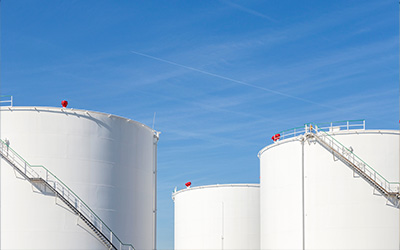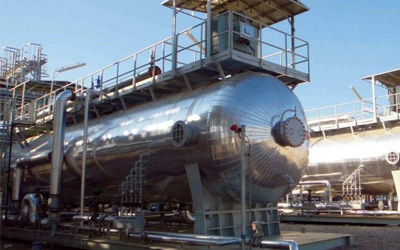
Every barrel counts. Don’t leave yours at the bottom.
The sludge accumulating in your tanks is not waste. It is recoverable crude oil
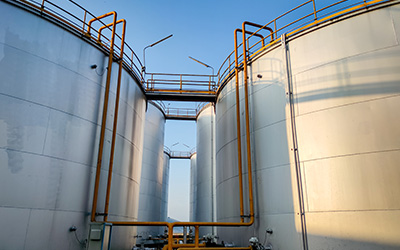
Understanding the Challenge
With the U.S. Strategic Petroleum Reserve at historically depleted levels — and active drawdowns underway in response to global supply disruptions — there is no longer any tolerance for recoverable crude oil that never makes it to market. But in thousands of large crude storage tanks across the country, that’s exactly what’s happening.
Sludge accumulates at the bottom of every crude storage tank. Over months and years, heavier hydrocarbon fractions — asphaltenes, paraffins, waxes, and entrained solids — settle and solidify into a dense, immobile layer that conventional pumping and mechanical operations simply cannot recover. In tanks at commercial terminals, pipeline facilities, and strategic storage sites, this sludge layer can consume 10–30% of total tank capacity, locking away barrels that are counted as storage but never delivered as product.
Conventional approaches make the problem worse. Mechanical cleaning — door-sheet cutting, bobcats, shovels, and manual labor inside a confined space — treats this sludge as waste to be disposed of. That means hauling away hazardous material at significant cost while leaving the intrinsic hydrocarbon value on the table. In a supply-constrained environment, that approach is no longer acceptable.
The sludge accumulating in your tanks is not waste. It is recoverable crude oil — and FQE Chemicals has the chemistry to prove it.
Common sludge-forming materials in crude storage:
• Asphaltene deposits
• Paraffin / wax crystallization
• Heavy resid bottoms
• Crude tank heel accumulation
• Entrained production sand and solids
• Pipeline debris and scale
• High-viscosity bitumen fractions
Primary Applications
Strategic Petroleum Reserve Tanks
Commercial Crude Storage Terminals
Pipeline & Midstream Storage Facilities
What is FQE Sludge Recovery Process?
FQE Chemicals’ proprietary tank cleaning process is engineered to do one thing that mechanical methods cannot: dissolve sludge entirely and return it to a pumpable, reusable hydrocarbon. Rather than excavating and disposing of sludge as hazardous waste, our chemistry liquefies it in place — inside the tank, in a closed-loop environment — and returns it to your process stream.
Our chemists custom-engineer a solvent solution using FQE® Solvent-H or FQE® Solvent-H+, blended with a hydrocarbon diluent (cutter stock) sized specifically to the composition of your sludge. This solution is introduced through roof-mounted or manway-mounted circulation nozzles and recirculated continuously, penetrating and dissolving even the most stubborn asphaltene and wax structures. Any solids dissolved by the solvents remain in solution even when pumped to an adjacent tank — eliminating the risk of re-solidification and ensuring the recovered hydrocarbon stays pumpable.
Once the sludge is fully solvated and pumped out for recovery, the tank is degassed and polished using FQE® LEL-Vapor, achieving a superior level of surface and atmospheric cleanliness suitable for inspection, repair, or return to service. The entire process is conducted without manned entry into the tank and without the generation of significant hazardous waste — only inorganic insoluble solids such as rust and production sand remain, classifiable as non-hazardous material.
Proven results across Gulf Coast crude storage operations:
- 95–98.5% hydrocarbon recovery from tank sludge volume
- $400,000 in unexpected revenue generated from a single crude tank cleaning
- Hazardous waste reduced from 10,200 barrels to under 100 barrels on a single project
- >98% of an 18,500-barrel sludge volume recovered from a high-wax content crude tank
- Up to 60% reduction in total cleaning time versus conventional mechanical methods
Key Features & Benefits
✓ Maximum Hydrocarbon Recovery
Recover 95–98%+ of the crude oil locked in your tank sludge and return it directly to your process stream or sell it as recoverable product — turning a disposal expense into a revenue event.
✓ Zero Man-Entry Required
Our closed-loop chemical circulation process eliminates the need for personnel to enter the tank during the sludge removal phase, dramatically reducing confined space exposure risk and HSE liability.
✓ Operates 24/7 — Deployable on Short Notice
Unlike people-intensive mechanical operations, FQE's chemical process runs continuously without shift restrictions. It can be mobilized rapidly to meet emergency drawdown schedules and unplanned operational demands.
✓ Hazardous Waste Virtually Eliminated
By dissolving organic solids in place and recovering them as reusable hydrocarbon, our process eliminates the overwhelming majority of hazardous waste generation — slashing disposal costs and environmental compliance burden.
✓ Catalyst-Friendly, Refinery-Compatible Output
The recovered hydrocarbon product — including dissolved asphaltenes, waxes, and resid fractions — has been engineered to be catalyst-friendly and suitable for direct reprocessing within refinery crude units, with BS&W typically under 2%.